Long-term
education, particularly since childhood, is important in
shaping the future behaviour of road users and fostering
a culture of road safety. In 2004, the Road Safety Council
employed a host of tools such as teaching kits, talks
and seminars, etc. to educate target groups including Youth & Students,
Schools, Drivers and General Public.
Youth & Students
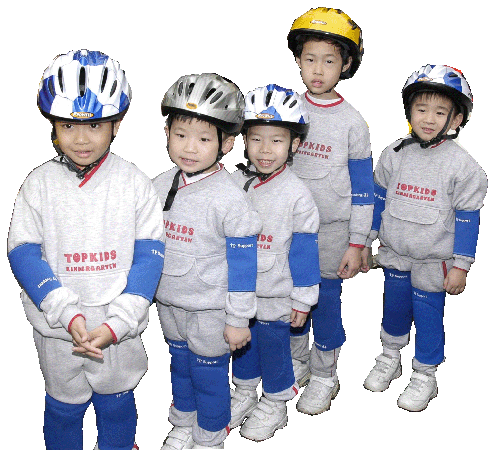
Proficiency Badge Scheme for Youth
In
February 2003, the Road Safety Council endorsed the initiative
of “Proficiency Badge Scheme for Youth” to create
greater awareness of road safety in children through inter-active
educational activities. A Working Group was set up to take
charge of implementation.
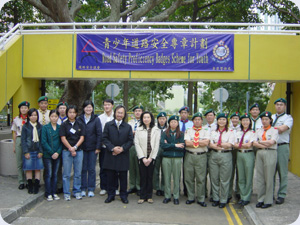
Road Safety Proficiency Badge Scheme for Youth
(Trial Scheme)
The
trial scheme was completed in October 2004 with favourable comments.
With this encouraging result, the Road Safety Council has approved
the introduction of the Scheme in collaboration with the Road
Safety Association in 2005.
Road Safety Town
Road
safety education takes on a new dimension at the Road Safety
Town where visitors can experience road safety activities with
simulated facilities.
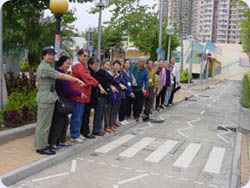
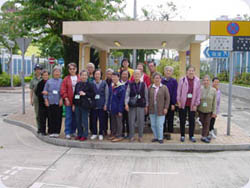
Elderly visitors
at Road Safety Town
There
are four Road Safety Towns located throughout the territory: North
Point, Sau Mau Ping, Shatin and Tuen Mun. Each Town is a miniature
replica of the road environment, where children receive training
as road users using simulated road facilities and
high-tech information kiosks - eight of which were installed in
2004. Road safety talks help kindergarten and primary school visitors
gain valuable insight and knowledge about road safety in order
that they can become safe drivers when they grow up.
The Towns are managed by the Leisure
and Cultural Services Department with bookings made under education
programmes operated by the Police. In 2004, a total of 64,666 visitors
were recorded. The popularity of the Towns has enabled expansion
of the scope of its visitors beyond kindergarten and primary school
goers. Recently, an increase of visit applications from resident
clubs, social groups, elderly organisations and other associations
is noted, indicating the increasing popularity of the Towns to other
walks of life. To further promote the Road Safety Towns, Open Days
were organised during the year.
Pak
Fuk Road Safety Town
Pak Fuk Road, North Point
Enquiry:2565 5716
Sau
Mau Ping Road Safety Town
56 Sau Ming Road, Sau Mau Ping
Enquiry:2379 1194
Shatin
Road Safety Park 1 Kong Pui Street, Shatin
Enquiry:2637 6303
Tuen
Mun Road Safety Town Wu Shan Recreation Playground, Tuen Mun
Enquiry:2463 7597
Road Safety Bus
Appreciation letters from
students
Welcome to the Road Safety
Bus
Launched
in the seventies, newly overhauled and fitted with hi-tech facilities
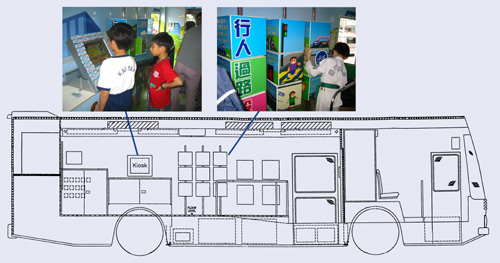
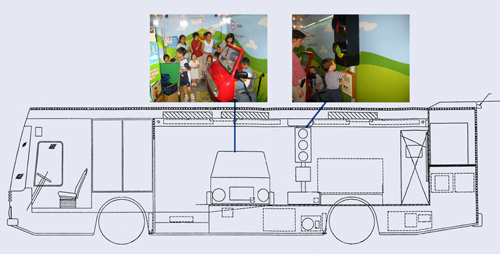
in 2003, the Road Safety Bus provides a mobile exhibition and presentation
platform for visiting schools, housing estates and youth centres.
The 9.7 metre vehicle is a low-floor single decker, with colourful
visuals on its body, simulated road environment and greenery
in the interior. It is also equipped with facilities for the disabled.
The
bus features digital and display sections with computer games and
interactive learning facilities for role play, quizzes and puzzles.
A story telling area is installed with pedestrian lights for lessons
in crossing the road safely. There is also a multimedia zone which
broadcasts APIs and other timely road safety information. Factual
and educational information is displayed at the exhibition corner.
During the year, 46,226 people visited the Road Safety Bus.
Pupils
gain a greater awareness of road safety in school through participation
in relevant activities and subjects such as General Studies at
primary level, Economic and Public Affairs, Social Studies and
Civic Education at junior secondary level. The learning activities
provide knowledge about road safety and help pupils develop proper
attitudes towards road safety. Topics include the importance of
road safety, common causes of traffic accidents, safety regulations,
and proper attitudes on the use of public transport.
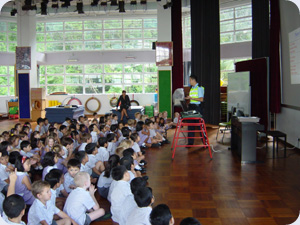
Road Safety talks to students
Under
the current curriculum reform, students are encouraged to develop
positive values and attitudes. Some personal and social values
relating to road safety are further strengthened in the school
curriculum. These values include self-discipline, respect for rules
and regulations, fulfilling civil duties and respect for others,
etc. Cultivation of these values and attitudes provides a solid
foundation upon which good road safety habits are built.
Learning by Doing
“Learning
by doing” is one of the important strategies in road safety
education. To this end, schools are encouraged to provide pupils
with opportunities to practise what is learned in class. These
learning activities begin as early as kindergartens, where visits
to Road Safety Towns is a popular outdoor activity through which
pupils learn about road safety in a simulated environment. We also
encourage schools to set up their Road Safety Patrols to reinforce
the importance of road safety to pupils.
To
facilitate teachers in conducting road safety education, the Education
and Manpower Bureau has produced Educational Television programmes
with a view to developing students’ proper attitudes in using
roads and public transport. Teaching plans on road safety education
are also produced to enhance pupils’ understanding of the
importance of observing traffic regulations.
Teaching Aids
The
Education and Manpower Bureau, in collaboration with voluntary
organisations and other government departments such as Information
Services Department, Transport Department, Hong Kong Police Force
and the Hong Kong Road Safety Association, provides schools with
teaching and reference materials on road safety. The Bureau also
helps promote the Road Safety Logo Design Competition, Road Safety
Symbol Competition and other related award schemes at schools
aiming at enriching pupils’ knowledge on road safety.
Teaching
aids, including videotapes and teaching kits about road safety,
are made available for schools at the Curriculum Resources Centre
of the Education and Manpower Bureau.
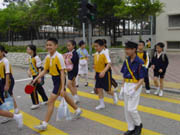
Pupils at the zebra crossing
Pupils crossing
the road
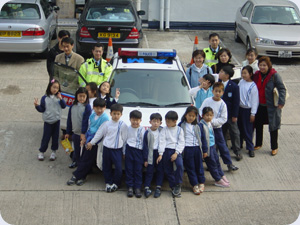
Lectures to kindergarten
students
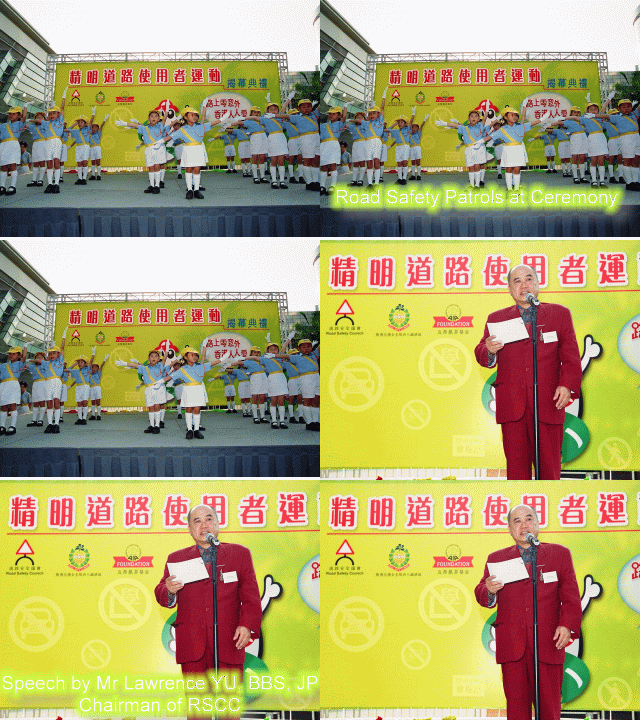
Road Safety Patrol teams
Drivers
Driving Improvement Scheme
The
Driving Improvement Scheme, launched in September 2002, has
proven to be effective in promoting road safety. The Scheme
allows drivers to attend to their problematic driving attitude
and behaviour and to rectify them through driving improvement
training courses.
Drivers
who have committed the scheduled offence incurring 5 driving-offence
points or above under the Road
Traffic (Driving-Offence Points) Ordinance may be directed by the court to attend a driving
improvement course as one of the penalty options. Apart from
being ordered by the court, drivers are also allowed to join
the driving improvement course voluntarily.
A
driver will have 3 driving-offence points deducted from his/her
total driving-offence points already incurred, subject to
satisfactory completion of the course, and be issued with
a course certificate. However, no point may be deducted from
the person who has completed the course and issued with a
course certificate if he/she:
Has not incurred any point or has incurred 15
or more points; or
the Commissioner for Transport has within the
past two years already deducted points from the total points
incurred by the person after he/she has completed the course
and issued with a course certificate
The
instructors of the course take an interactive approach in
delivering the course. They achieve the goals of the course
through experience sharing, discussion and a number of activities.
The course is delivered in Cantonese, English and Putonghua.
Up until 31 December 2004, a total of 4,100 drivers have
attended the course.
General Public
Various
channels are employed to educate the public on road safety.
They range from the mass media to on-street education during
which leaflets are distributed to target groups. Talks, carnivals,
competitions and other community activities are also arranged.