| |
| Education |
| |
| Educating
the young today is instilling a set of human and moral values
to shape a responsible society for tomorrow. It is the cornerstone
of our Three C's — Care, Concern and Commitment —
to road safety. |
 |
|
| |
| Spearheading
our educational drive for the entire community is the very comprehensive
Road Users' Code, the "bible" of road safety. Divided into
10 chapters it covers vital information for all road users, pedestrians,
passengers, cyclists, all drivers, including professional drivers
and motorcyclists. It also covers the language of the road —
signals, traffic lights, temporary signs etc — with training
programmes for our children as road users and what to do in emergencies
and traffic accidents. |
| |
From
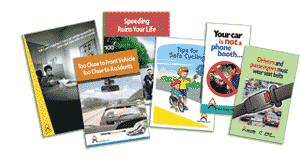
the Code has spawned numerous leaflets, brochures, booklets, posters,
video tapes and educational tools, each advocating a particular aspect
of road safety to a specially targeted audience. These are updated
when there are changes to the Law, new initiatives are instigated
or improvements made to road signage. These publications are available
at all Transport Department Licensing Offices, Police Stations, District
Offices, the Internet and other outlets.
|
| |
|
Multi-agency Approach
An
important aspect of effective education is reaching out to
the community, the hard sell of the product: road safety.
This means involving the community in various activities through
the District Councils, schools and centres for the elderly.
Talks, seminars, carnivals and visits are provided by the
Police through the various organisations needing their help
to spread the word of the crucial elements of the Three C's.
'Smart Driver' Education
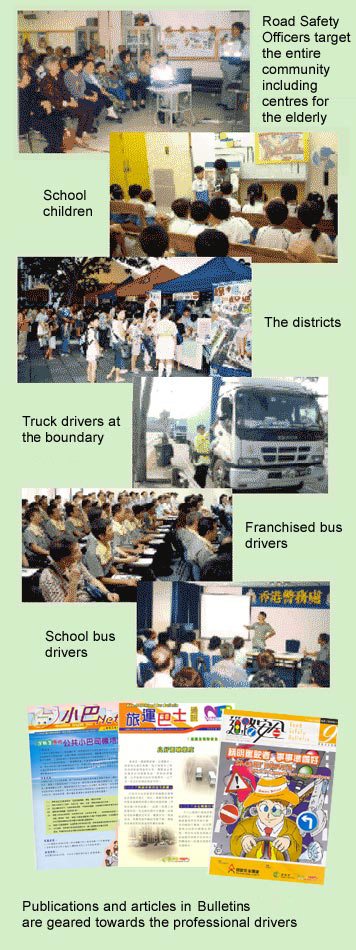
Many private
firms and organisations employing large fleets of vehicles
enlist the help of the Police to educate their drivers on
considerate road usage and vehicle maintenance. Each year,
as the road safety message spreads, more and more firms are
joining the scheme. With the Transport Department, the Police
assist public transport and professional drivers with seminars
focusing on smart driving skills, correct road manners, road
safety, accident black sites and driving fatigue.
|
 |
|
|
|
Targeting
professional drivers has been high on the agenda of the Road
Safety Council, taking into account the sheer size and velocity
of the vehicles, the large numbers of passengers they carry,
and the hours they spend on the road. as witnessed last year
on the Tuen Mun Road, accidents involving heavy vehicles can
have a devastating effect on the community.
To improve the quality of driving in Hong Kong, information
on the problems encountered and common mistakes made by drivers
is shared with public transport operators, trade associations,
driving instructor assocations and driving school operators.
|
| |
|
Education targeting Cyclists, Pedestrians
and Passengers
|
| |
 |
Education
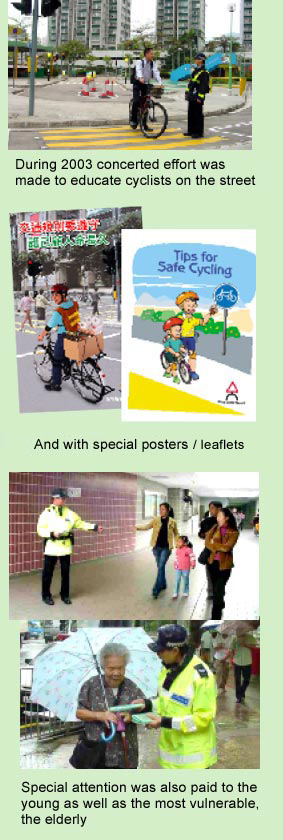
to other road users is not ignored. In view of the upsurge in
traffic accidents involving bicycles, especially in the New
Territories, the Council has placed more emphasis in promoting
safe cycling in districts and schools and areas where bicycles
are commonly used as a mode of transport. As part of the publicity
programme, the Police warn cyclists about the awareness of road
usage, to be alert to the people and vehicles around them and
to follow the safety rules and to wear protective gear when
cycling.
Wayward pedestrians
have been another target for special education programmes. Visits
are made to homes and clinics for the elderly, who are extremely
vulnerable to road accidents. Volunteers, the Social Welfare
Department, District Councils and others organise events to
advise the elderly to be careful when crossing the road. Police
and traffic wardens monitor pedestrian crossings, warning those
crossing the street against red lights. "Mobile Classrooms"
are used to educate pedestrians who commit minor offences rather
than being punished for their infraction.
|
|
| Road safety education to passengers is continuing.
They are always reminded of the requirements for wearing seat beats
and that safety seat belts can help to reduce the severity of injury
in an accident. Advice is also given to them on the rules relating
to riding in a private car, taxi and other public transport, like
school buses and nanny vans. This is an integral part of road safety
education and every road user must understand that they have a share
of responsibility in road safety. |
| |
|
School Educational Programme
|
|
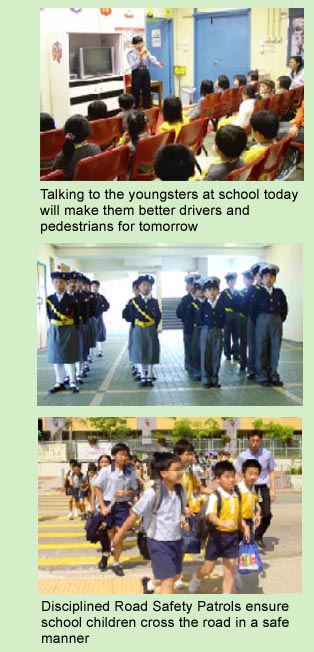
To reach
the objective of developing responsible road users, education
starts at kindergarten and is an important part of the school
curriculum. At primary level it comes under General Studies
and at junior secondary level, road safety is covered in Economic
and Public Affairs, Social Studies and Civic Education subjects.
And, of course, the Road Safety Towns provide a hands-on experience
for kindergarten and primary pupils.
During this
development process, students acquire fundamental knowledge
on the importance of road safety, causes of common traffic
problems, safety regulations and proper attitudes on the use
of public transport and ingrained basic knowledge of good
driving behaviour as they are the drivers of the future.
Personal and social values are also strengthened in the school
curriculum which includes self-discipline, respect for rules
and regulations, carrying out duties as citizens of the community
and respect for others. It is the learning of these values
and attitudes which builds a solid foundation for good road
safety habits.
|
 |
Assisting teachers
to promote road safety education is a series of Educational Television
programmes produced by the Education and Manpower Bureau aimed at
further developing students' proper attitudes on the road and on public
transport. Other teaching plans have also been produced by the Bureau
to enhance the understanding of traffic regulations. |
| |
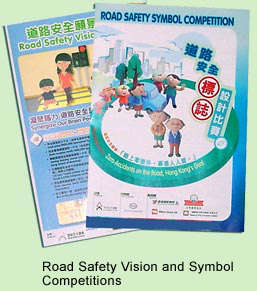 |
The
Bureau also collaborates with other government departments and
voluntary organisations ─ the Information Services Department,
Transport Department, Hong Kong Police Force and the Hong Kong
Road Safety Association ─ to provide schools with teaching and
reference materials on road safety. This collaboration provides
an opportunity for students to participate in the Road Safety
Symbol Design Competition and other award schemes.
Teaching aids,
including videotapes and teaching kits about road safety, are
available for schools' use from the Curriculum Resources Centre
of the Education and Manpower Bureau. |
|
| |
| Youngsters take to the Streets
in Learning Curve
|
|
Scattered
throughout Hong Kong are pockets of small communities with
no permanent residents; just thousands of transient visitors
who spend a few hours a day walking and driving around the
streets.
These are
the Road Safety Towns, operated by the Hong Kong Police in
North Point, Sau Mau Ping, Shatin and Tuen Mun to provide
hands-on road safety training for children. And to make the
visit more impressive and the road safety message more sustainable,
the towns are built around a simulated road environment complete
with different road crossing facilities.
Managed by
the Leisure and Cultural Services Department, with bookings
under education programmes operated by the Police, the four
Road Safety Towns attracted 44 276 visitors in 2003.
Apart from
hands-on training for young pedestrians, the towns also provide
opportunities for children to become future model drivers
by practising the concept of being a safe driver. Each town
has been upgraded with interactive road safety games providing
a quality presentation for kindergarten and primary school
children. Hi-tech kiosks entertain the children with pedestrian
and cycling skills and the basic requirements for a safe driver
while other on-site activities include road safety story telling
and puppet shows. Open Days are also organised for parents,
teachers and the public to publicise the towns and the benefits
they bring from learning road safety.
Members of
the Road Safety Patrols have been trained-up to be "Road
Safety Town Assistant Pioneers" and assist the Police
in receiving visitors during weekends. Not only do the Patrols
serve as Road Safety Ambassadors but also provide an opportunity
for the youngsters to serve the community as well.
These towns
play an invaluable and diverse role in spreading the road
safety message. Initially seen as an excellent means of education
for the children of Hong Kong, their role has grown substantially
in recent years as seen by the increasing visits from local
resident clubs, social groups, elderly organisations and community
at large.
Continuous
efforts are being made by the Police to upgrade the service
and facilities in the towns
|
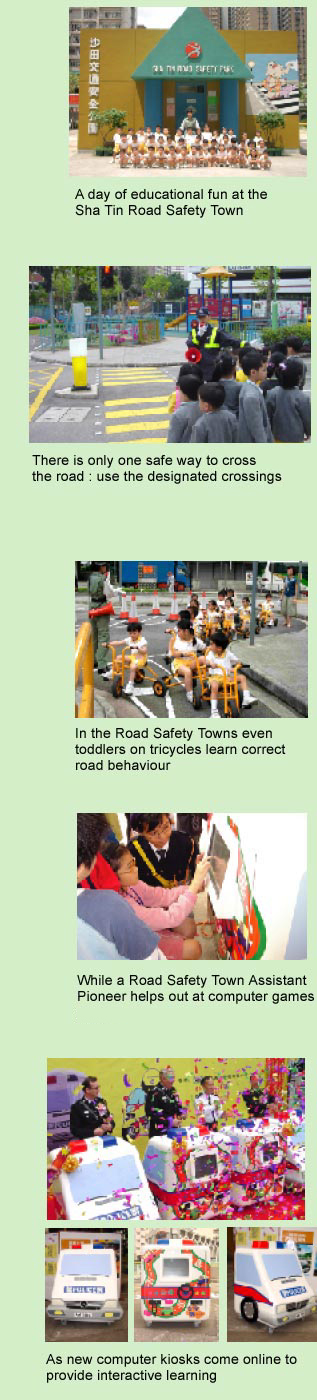 |
to keep pace with e-technology, making road safety learning more interactive
and providing a quality service to the public. Another eight interactive
kiosks will be installed in the Road Safety Towns during 2004. |
| |
Road Safety Bus
|
 |
One
bus plying the highways and byways of Hong Kong stands out with
distinction. Actually, it could be called a school bus as it
does stop off at schools throughout the territory, but not as
a means of transport taking children to their place of learning.
|
It is the Road
Safety Bus, first introduced by the Hong Kong Police Force in
the seventies as a mobile lecture centre disseminating the road
safety message to the public, especially children. Throughout
the years, it has achieved remarkable success spreading the
road safety message to a vast cross section of the community.
But times are
forever changing and in January 2003 a newly designed Road Safety
Bus, fully equipped with hi-tech facilities, was officially
launched, marking a new milestone in road safety publicity and
educational work. |
|
| |
|
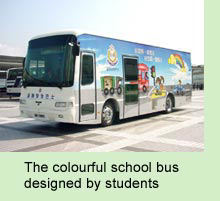
Keeping children
actively involved in road safety activities has always been
a major component of the road safety campaign, so-much-so
that the colourful design of the bus body was drawn from the
winning entries of the Livery Design Competition, which attracted
more than 2,300 contributions from primary and secondary schools
throughout the territory.
The new Road
Safety Bus, 9.7m in length, is a low floor single decker.
Its interior encompasses a simulated road environment with
a touch of greenery.
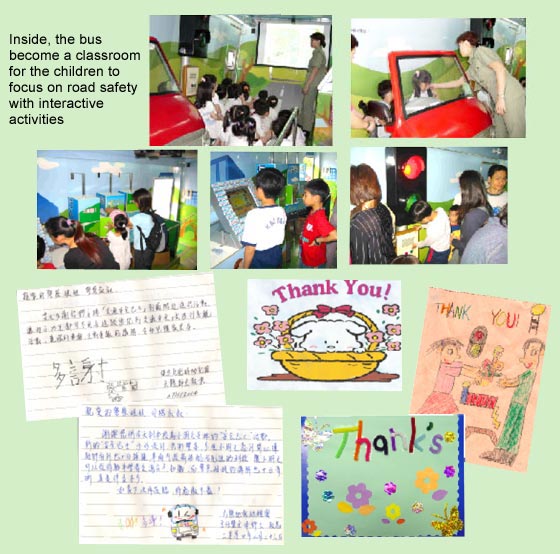
On-board facilities
include an exhibition corner, a computer zone, and a lecture
area. Interactive road safety
|
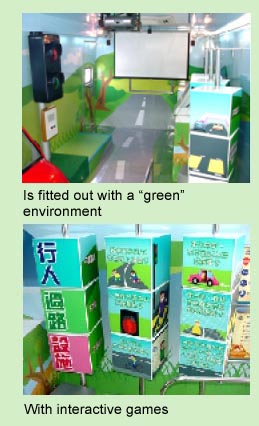 |
| learning facilities
include an information kiosk providing road safety information,
computer games and simulated driver and passenger seats. Our
drivers of tomorrow can role play a number of activities to
become safe drivers or passengers while reinforcing their road
safety knowledge. Eventually, they will become "Smart Drivers
and Bright Pedestrians" when they grow up. |
|
| |
As
the attention span of children is limited to seconds, making
the learning process more interesting has been a real challenge
for the designers. Road safety quizzes and puzzle games have
been introduced, allowing the children to absorb road safety
knowledge more readily through games and thinking. A set of
pedestrian lights accompanied with road safety story telling
facilities teach the children how to cross the road safely.
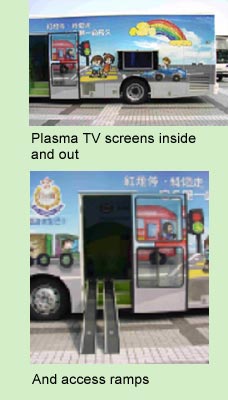
A LED panel
is installed on the bus displaying timely road safety information
and a plasma TV simultaneously broadcasts road safety messages
and Announcements in the Public Interest (APIs) inside and outside
the bus. The bus is also equipped with facilities for the disabled.
|
 |
|
The
new Road Safety Bus is now running around in the territory visiting
kindergartens, primary schools and the community, taking an active
role in disseminating the road safety message to the people of Hong
Kong.
Please click www.roadsafety.gov.hk
to visit the Road Safety Bus. |
 |
|
