|
Engineering and Vehicle Maintenance
|
||
|
Effective
road safety involves a cycle of components dependent upon each
other; a flaw in any component renders the others meaningless.
Throughout this report reference has been to the road users, the
drivers and pedestrians alike. But equally important are the vehicles
themselves and the roads they travel on.
|
||
|
Site Investigations and Improvements
|
||
|
||
|
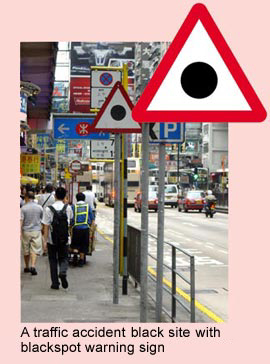
A blacksite
list is compiled quarterly by the Transport Department (TD)
in accordance with the threshold criteria of: |
||
|
|
||
|
||
|
|
||
| The Black Site Investigation Programme | ||
|
|
||
|
At the 150
sites investigated in 2003, the remedial measures were usually
small scale, low cost schemes which were quick and simple to implement.
The black site investigation programme is effective as evidenced
by the fact that the number of black sites has been gradually
reduced over the years. There were 140 black sites in 1994. With
the same threshold criteria as adopted in 1994, the number of
black sites in 2003 was 60.
|
||
| MASS Action | ||
|
|
||
|
||
| Area Studies | ||
|
||
|
Ongoing Studies
|
||
|
The Area Study concept was first introduced
into the accident investigation and remedy programme in 1999.
Two studies have been conducted each year since then. Recommended
remedial measures have been gradually implemented. Area Study
may be able to resolve otherwise intractable traffic problems.
However, remedial measures recommended in an Area Study usually
involve area-wide traffic management and take a relatively longer
time to agree and implement. The effectiveness of Area Study will
be closely monitored.
|
||
| Improving Road Signage | ||
|
||
|
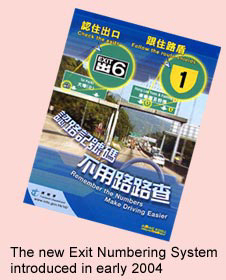
Under the new
system, drivers can identify their destination via the exit number
well before the turn-off. The distance markers provide drivers
with their exact location on the highway in the event of an emergency
or breakdown. The markers also indicate the highway route number
and the direction of travel.
|
||
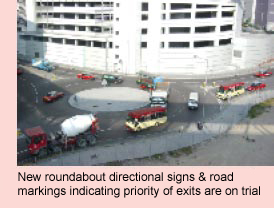
| Improving Road Safety at Roundabouts | ||
|
||
| Autotoll Markings | ||
|
||
| Engineering Measures | ||
|
||
|
||
|
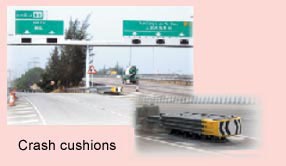
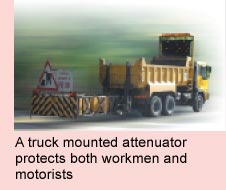
A water-filled
barrier system was also set up at an emergency opening of Tin
Ying Road, Tin Shui Wai, to ascertain its performance on a 70
km/h road. This test installation is designed to absorb the impact
force of an errant vehicle running out of track and reduce the
severity of damage and personal injury.
|
||
| Roadworthiness and Vehicle Safety | ||
|
||
|
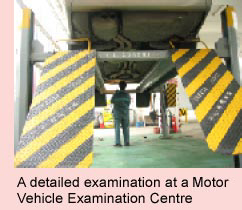
Vehicle Examinations and
Type Approvals:
Before a vehicle is registered, a prototype must normally undergo type approval and be checked to ensure that the vehicle complies with Road Traffic (Construction and Maintenance of Vehicles) Regulations. |
||
|
Pre-Licensing Inspections:
All vehicles, whether it be for private or commercial use, must be tested for roadworthiness before being issued with a vehicle registration certificate. Vehicles are inspected at authorised inspection depots and if any defects are detected, the road worthiness certificate will not be issued until the defects are rectified. Thereafter, all commercial vehicles and private cars over six years old are subject to annual inspection. |
||
|
Franchised Buses:
Spot checks and close monitoring of franchised buses have resulted in higher standards of maintenance throughout the industry. There are also call-up inspections of non-franchised buses to ensure their safety and that of their passengers. |
||
|
||
| General Vehicle Safety | ||
|
Legislation
has been passed that passenger safety belts and high back seats
be installed on public light buses registered on or after 1 August
2004. Passengers will be required, by law, to strap themselves
in when boarding a public light bus with safety belts provided
for and it will be the passenger's responsibility to ensure this
requirement is met.
Meanwhile, regular liaison meetings are held with transport organisations and vehicle manufacturers to ensure improved safety measures of vehicles. Currently on the agenda is the installation of halogen headlights. |
||
| New Route Numbering System Completed | ||
|
To enhance
road safety, the Transport Department completed the route numbering
system on all major trunk roads at the end of January 2004. Route
numbers are arranged in a more logical manner. The three north-south
routes (Routes 1, 2 and 3) pass through the three cross harbour
tunnels. The four east-west routes (Routes 4, 5, 7 and 8) have
sequences starting from south to north. The circular Route 9 encompasses
the New Territories. Motorists can plan their route and make early
directions without sudden lane change.
|
||
 " markings on the road to steer motorists into the
correct lane for autotoll clearance, thus reducing sudden
lane changing. Transverse yellow lines were also painted
before toll plazas to warn motorists to lower speed.
" markings on the road to steer motorists into the
correct lane for autotoll clearance, thus reducing sudden
lane changing. Transverse yellow lines were also painted
before toll plazas to warn motorists to lower speed. 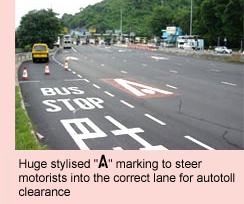
 |