| 
While
various Government departments devote a great deal of time and
effort in a bid to reduce the number of accidents on Hong
Kong’s roads, the maintenance of vehicles by owners themselves
also contributes significantly to road safety.
Work
by Government
Site Investigations and Improvements
Where
common factors leading to accidents are identified at certain sites,
remedial measures can be developed to prevent, or at least minimise,
the occurrence of traffic accidents. Efforts will be made to remedy
the situation by improving the road environment or providing additional
warnings to road users.
Priority for investigation is given to the following sites:
- Those with a higher accident rate or where serious
traffic accidents have taken place
- Those with a lower accident rate but which capture
public attention
- Those recording a sudden rise in accident rate
A
traffic accident black site list is compiled quarterly by the Transport
Department in accordance with the following criteria:
(i) Six or more traffic accidents involving pedestrian injury
for a 12-month period; and
(ii) Nine or more injury traffic accidents of any description
for a 12-month period.
Maintaining
our roads in top condition is the result of joint effort by the
Police, Transport Department and Highways Department through the
Traffic Accident Reduction Co-ordination Committee (TARCC).
During
2004, the Transport Department carried out investigations at 108
sites, including traffic accident blacksites, and other locations
described above.

The Blacksite Investigation
Programme
Of
the 108 sites investigated in 2004, remedial measures taken were
usually on a small scale. Low cost schemes which were quick and
simple were implemented. Effect of the blacksite investigation
programme is evident in the gradual reduction of blacksite numbers
over the years. There were 140 blacksites in 1994, which were
drastically reduced to 66 in 2004 using the same threshold criteria
adopted.
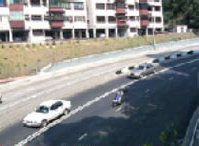 |
| Laying anti-skid materials |
MASS Action
MASS
action is the Multiple Application of Standard Solutions applied
to particular accident sites. It is a very useful technique which
allows the efficient use of limited manpower resources to study
accidents. Known effective accident reduction measures can be
implemented at a large number of locations with a comparatively
small amount of study at each location.
Area Studies
Accident
situations at a designated area are examined and the results may
lead to comprehensive improvements to the environment of the area
or a comprehensive traffic management scheme. Remedial measures
may also be taken, which may have a significant impact on local
traffic and transport arrangements.
Engineering Measures
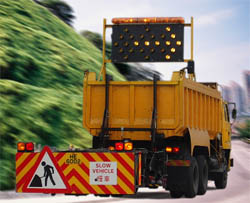 |
| Escort vehicle equipped with multiple sequence
warning sign and
truck mounted attenuator |
To
enhance safety in carrying out road works on expressways, the Highways
Department had introduced a number of new safety products for lighting,
signing and guarding measures. These products included multiple
sequence warning signs to warn drivers to watch out for road works
and truck mounted attenuators to reduce the severity of accidents
as a result of tailing errant vehicles crashing into slow moving
works vehicle fleets. In addition, the Highways Department has
been collaborating with the Transport Department and Hong Kong
Police Force in continuous development of working procedures and
guidelines on how road works should be lit, signed and guarded.
The use of updated safety products and working procedures will
be incorporated in the new version of the Code of Practice for
the Lighting, Signing and Guarding of Road Works to be issued in
2005.
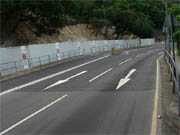 |
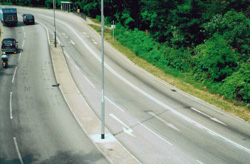
| Field trial of anti-skid materials at Tai Po
Road |
Besides
continuous improvement on lighting, signing and guarding of road
works, major engineering solutions for enhancing road safety also
include the application of anti-skid treatment and street lighting
improvements. The Highways Department continues to conduct research
on improving the performance of anti-skid materials and developing
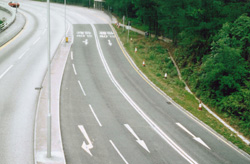
new materials suitable for use on asphalt roads. Field trials of
acrylic and thermoplastic anti-skid materials commenced in early
2004. The effect of the new materials is being monitored.
|
|
|
Before Laying anti-skid materials
|
After Laying anti-skid materials
|
Maintenance
of Different Vehicles
Vehicle Approval and Registration
Every
new type of vehicle will normally need to undergo type approval
to ensure that the vehicle type complies with the Road Traffic
(Construction and Maintenance of Vehicles) Regulations. Before
each vehicle is registered, it will have to be examined for roadworthiness
unless product conformity is assured by the manufacturer and accepted
by the Transport Department.
Annual Inspections
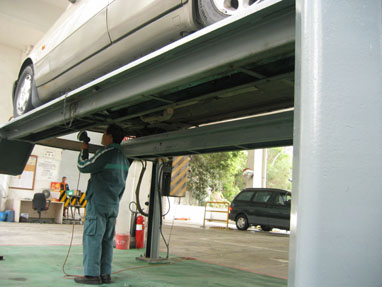
All
commercial vehicles, irrespective of their age, and all private
cars over six years old are subject to annual inspection before
their licences are renewed. The vehicles are tested and inspected
at designated vehicle inspection centres and they cannot be re-licenced
unless they pass the annual inspection. If defects are found,
they will need to be rectified first.
Franchised Buses
Spot
checks and close monitoring of franchised buses have resulted
in higher standards of maintenance throughout the industry. There
are also call-up inspections of non-franchised buses to ensure
their safety for both drivers and passengers.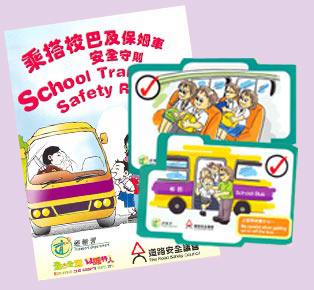
School Transport Vehicles
Special
attention is paid to the safety of school buses and all operators
must hold valid passenger service licences and passenger service
certificates for their vehicles. An inter-departmental working
group meets regularly to ensure passenger safety on these vehicles,
including installation of safer seats, comprehensive driver training
and concerted publicity and education for parents and students.
|