Road Safety Measures

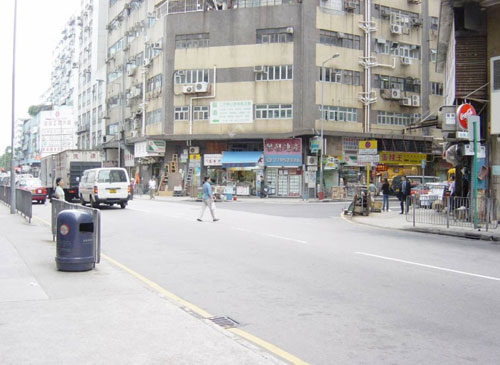
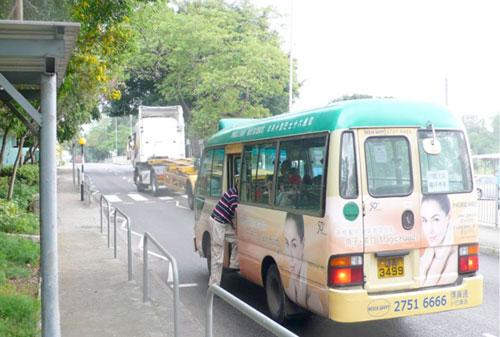
In addition to the local traffic improvement measures, the Transport Department has conducted route studies and investigations at 100 accident black spots to identify potential safety problems on roads and use a holistic approach to implement road improvement measures that enhance road safety along the routes and black spots concerned. Some examples are illustrated below.
 |
 |
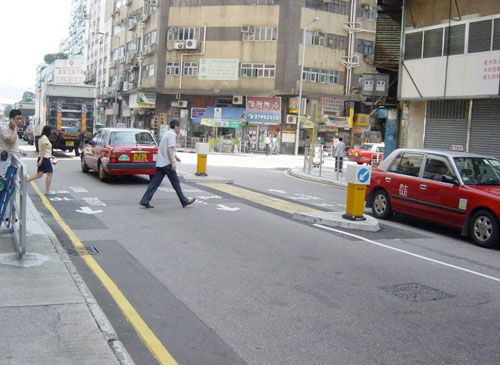 |
| Pedestrians find it difficult to cross a wide two-lane, two-directional road | A refuge island is provided between the traffic lanes for pedestrians to pause and check for approaching traffic |
 |
|
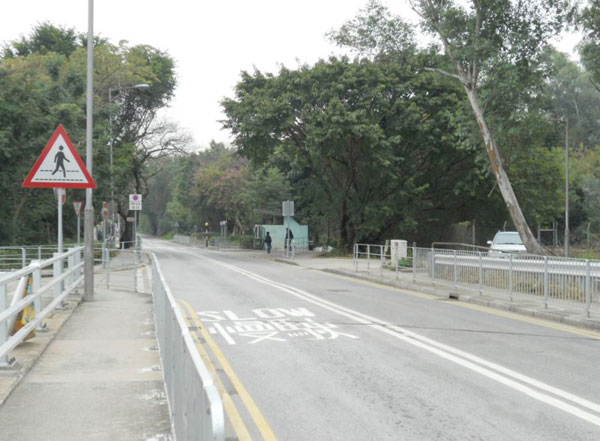 |
| Undesirable kerbside loading/unloading provokes vehicles overtaking into the oncoming traffic lane | Double yellow lines and double white lines are added to deter kerbside loading/unloading and prohibit overtaking. Additionally, a ‘pedestrian crossing ahead’ traffic sign and ‘slow’ road marking are added to remind drivers to slow down when approaching the zebra crossing ahead. |
The Transport Department is making use of technology to enhance road safety. For example, traffic signals are installed at about 1,800 road junctions to safely regulate and control vehicular and pedestrian traffic. About 155 red light cameras have been installed to deter drivers from jumping red lights. In addition, about 110 speed enforcement camera housings have been in operation to deter speeding.
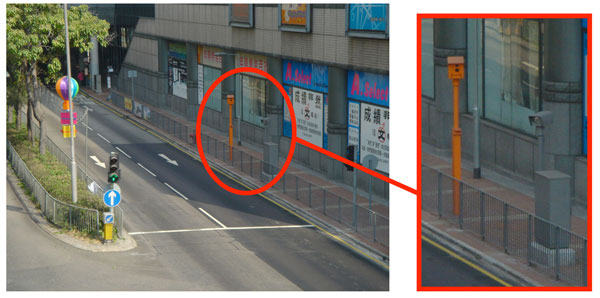 |
| Red Light Camera |
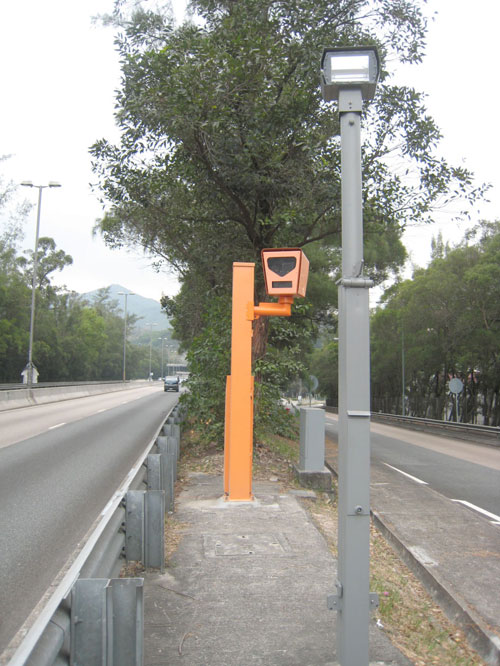 |
| Speed Enforcement Camera |
Engineering Measures
Central dividers are provided on dual carriageways to separate vehicles travelling in opposite directions. However, to facilitate the movement of emergency vehicles across central dividers in emergencies, Emergency Crossings (ECs) are provided at selected locations. Also, to cater for serious traffic congestion caused by major incidents, Contingency Crossings (CCs) are provided at selected locations to facilitate traffic diversion. ECs and CCs have typically been closed by tubular crash gates that provide separation between opposite traffic flows and prevent abuse by road users.
With a view to enhancing road safety and seeking better road facilities, the Highways Department and Transport Department have been working closely with the Hong Kong Police Force and Fire Services Department to study ways of improving the installation of ECs and CCs. The aim is to replace tubular crash gates with more robust barriers that will strengthen road safety and facilitate the movement of emergency vehicles across central dividers under emergency conditions.
Movable Steel Barrier (MSB) is especially designed for ECs and can be opened in a short time to allow the rapid passage of emergency vehicles. Under normal conditions, the MSB rests on the ground, with strong hinges fixed at each end, functioning as a robust barrier. When required, the MSB can be quickly opened.
In general, an MSB can be opened to 45 degrees to provide adequate space for the passage of emergency vehicles, and can be easily opened or closed within two minutes. They also provide adequate containment capacity when closed to prevent out-of-control vehicles from entering the opposite traffic lane. These properties make MSBs an effective and safe installation for ECs.
Some of the openings in central dividers are not considered ECs. However, in cases of a major traffic incident, these openings may be employed to facilitate traffic diversion. Such openings are categorised as Contingency Crossings (CCs). To allow for flexibility, barriers at CCs are designed to be removable. However, unlike ECs that require opening within a few minutes, the use of a CC is essentially to facilitate the diversion of traffic when flow in one of the two directions is paralysed due to a major incident. Removable Concrete Barrier (RCB) is therefore a suitable installation for CCs on major roads.
RCB is a series of short pre-cast concrete barrier sections interconnected by hinges and locked with steel pins to form a continuous barrier. The design of this type of barrier is robust. After installation, it is very effective at preventing out-of-control vehicles from entering the opposite traffic lane.
The main difference between EC and CC is the time required to open them. For non-urgent incidents, such as serious traffic congestion in one direction, Highways Department will arrange for a contractor to remove the steel locking pins between
pre-cast units, after which the RCB can be removed using a hoist. The RCB system allows for opening of the crossing in about one to two hours. The use of RCB at CC offers easier maintenance and lower installation costs than MSB at EC.
Highways Department plans to install MSB or RCB at 127 openings in the central dividers of major roads in Hong Kong, depending on the nature of the crossings. At the end of 2011, a total of 37 MSB and 51 RCB installations had been completed. Under the programme, over 90% of the improvement works will be completed by the end of 2013. Improvement of the remaining ones, which are affected by other road projects, will be completed as part of those projects.
Vehicle Examination
All vehicles registered in Hong Kong are required to undergo type approval and a pre-registration examination to ensure that they meet the requirements stipulated in the Road Traffic Ordinance. All commercial vehicles, including goods vehicles, buses, light buses, taxis and trailers, are required to pass a pre-registration examination and a yearly roadworthiness examination. All private cars of six or more years old are required to pass an annual examination. It is the responsibility of vehicle owners to properly maintain their vehicles to ensure their roadworthiness.
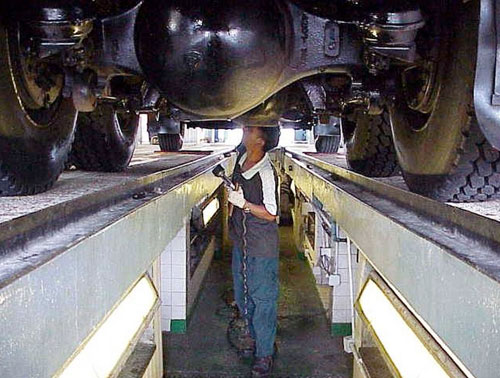
In 2011, the Transport Department continued to review and update local vehicle regulations and introduced a bill mandating speed limiters and electronic data recording devices on public light buses, to enhance their operational safety.


